Dennis Krämer
Dennis Krämer is a sociologist at the University of Münster.
His research examines how societies and cultures deal with sex and gender diversity in fields such as sport and medicine. He is particularly interested in how discourses and practices change over time, how problematizations, pathologizations, and struggles for recognition are bound up with larger epistemic transformations and embedded in wider sociopolitical contexts, and, above all, what role conceptions of the body in the natural and social sciences play in how societies perceive sex and gender diversity.
A second area of his research addresses the question of how societies deal with crisis situations, how they interpret them discursively and overcome them in practice, and how they can build resilience. In this context, he is the founder of the DFG-funded international research cooperation “Resilient Healthcare in Times of Multiple Crises” (RE-CARE).

Publications
-
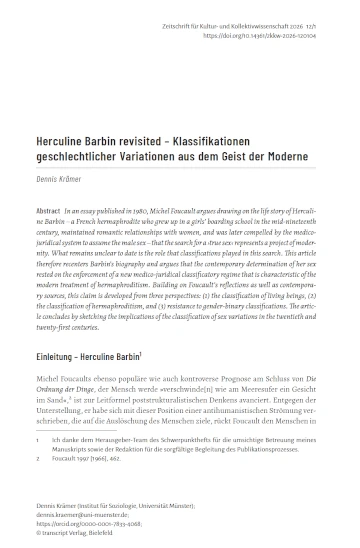
Herculine Barbin revisited: Klassifikationen geschlechtlicher Variationen aus dem Geist der Moderne
Zeitschrift für Kultur- und Kollektivwissenschaft 12(1): 49–76.
DOI: 10.14361/zkkw-2026-120104
Abstract
In an essay published in 1980, Michel Foucault argues, drawing on the life story of Herculine Barbin – a French hermaphrodite who grew up in a girls’ boarding school in the mid-nineteenth century, maintained romantic relationships with women, and was later compelled by the medico-juridical system to assume the male sex – that the search for a ›true sex‹ represents a project of modernity. What remains unclear to date is the role that classifications played in this search. This article therefore recenters Barbin’s biography and argues that the contemporary determination of her sex rested on the enforcement of a new medico-juridical classificatory regime that is characteristic of the modern treatment of hermaphroditism. Building on Foucault’s reflections as well as contemporary sources, this claim is developed from three perspectives: (1) the classification of living beings, (2) the classification of hermaphroditism, and (3) resistance to gender-binary classifications. The article concludes by sketching the implications of the classification of sex variations in the twentieth and twenty-first centuries.
-
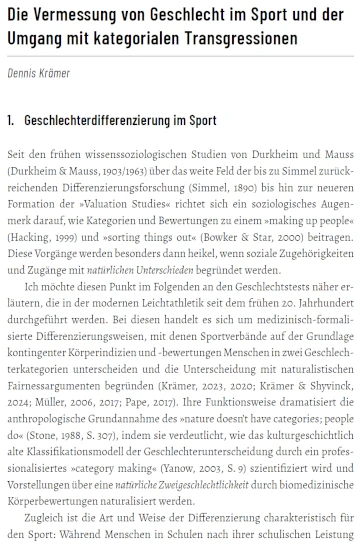
Die Vermessung von Geschlecht im Sport und der Umgang mit kategorialen Transgressionen
In: Robert Schmidt, Max Weigelin, David Kempf (Eds.): Leistungsvergleiche und evaluative Praktiken. Bielefeld: transcript, pp. 93–123.
DOI: 10.1515/9783839472361-005
Abstract
The article examines the evaluative infrastructure that underlies the sorting of people by sex and gender in sport. Using the example of professional athletics and with reference to intersex and trans people, it asks how sex and gender variations are fitted into a binary system of sport through processes of categorization and measurement, how bodies are objectified to this end, and how the formalization of categories and the practice of categorization change over time.
-
Intersexualität im Sport. Mediale und medizinische Körperpolitiken
Bielefeld: transcript, 459 pages.
Abstract
The study is based on a discourse analysis carried out between 2015 and 2019. It centres on the question of how the media and medical discursivisation of intersex athletes in sport changed from the early twentieth to the early twenty-first century, and how certain underlying patterns of professional elite sport such as binary gender categorisation, medical treatment, and the principle of fair play are connected to the social situation of their respective period. The empirical basis consists of three intersex athletes whose discursivisation is examined in three socio-historical contexts (National Socialism, the Cold War, postmodernity): Dora Ratjen, Ewa Kłobukowska, Caster Semenya.
-
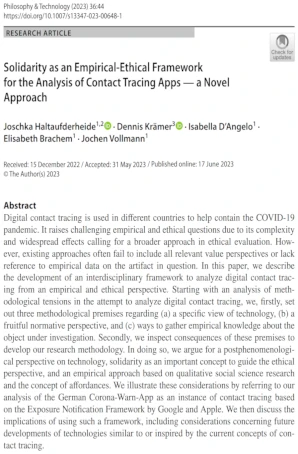
Solidarity as an Empirical-Ethical Framework for the Analysis of Contact Tracing Apps — A Novel Approach
Philosophy & Technology 36, 44.
DOI: 10.1007/s13347-023-00648-1
Abstract
Digital contact tracing is used in different countries to help contain the COVID-19 pandemic. It raises challenging empirical and ethical questions due to its complexity and widespread effects calling for a broader approach in ethical evaluation. However, existing approaches often fail to include all relevant value perspectives or lack reference to empirical data on the artifact in question. In this paper, we describe the development of an interdisciplinary framework to analyze digital contact tracing from an empirical and ethical perspective. Starting with an analysis of methodological tensions in the attempt to analyze digital contact tracing, we, firstly, set out three methodological premises regarding (a) a specific view of technology, (b) a fruitful normative perspective, and (c) ways to gather empirical knowledge about the object under investigation. Secondly, we inspect consequences of these premises to develop our research methodology. In doing so, we argue for a postphenomenological perspective on technology, solidarity as an important concept to guide the ethical perspective, and an empirical approach based on qualitative social science research and the concept of affordances. We illustrate these considerations by referring to our analysis of the German Corona-Warn-App as an instance of contact tracing based on the Exposure Notification Framework by Google and Apple. We then discuss the implications of using such a framework, including considerations concerning future developments of technologies similar to or inspired by the current concepts of contact tracing.
-
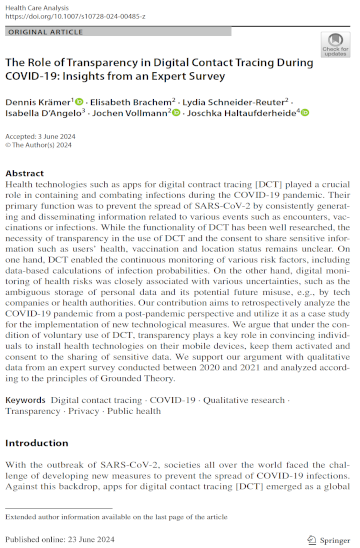
The Role of Transparency in Digital Contact Tracing during COVID-19: Insights from an Expert Survey
Health Care Analysis.
DOI: 10.1007/s10728-024-00485-z
Abstract
Health technologies such as apps for digital contact tracing (DCT) played a crucial role in containing and combating infections during the COVID-19 pandemic. Their primary function was to prevent the spread of SARS-CoV-2 by consistently generating and disseminating information related to various events such as encounters, vaccinations or infections. While the functionality of DCT has been well researched, the necessity of transparency in the use of DCT and the consent to share sensitive information such as users’ health, vaccination and location status remains unclear. On one hand, DCT enabled the continuous monitoring of various risk factors, including data-based calculations of infection probabilities. On the other hand, digital monitoring of health risks was closely associated with various uncertainties, such as the ambiguous storage of personal data and its potential future misuse, e.g., by tech companies or health authorities. Our contribution aims to retrospectively analyze the COVID-19 pandemic from a post-pandemic perspective and utilize it as a case study for the implementation of new technological measures. We argue that under the condition of voluntary use of DCT, transparency plays a key role in convincing individuals to install health technologies on their mobile devices, keep them activated and consent to the sharing of sensitive data. We support our argument with qualitative data from an expert survey conducted between 2020 and 2021 and analyzed according to the principles of Grounded Theory.