Resilient Healthcare in Times of Multiple Crises: Connecting Germany and Japan [RE-CARE]
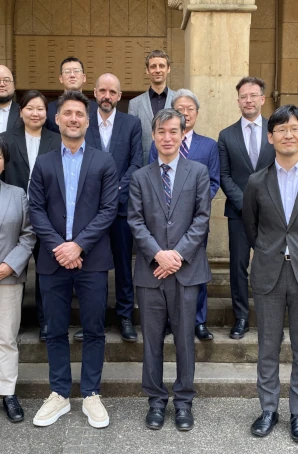
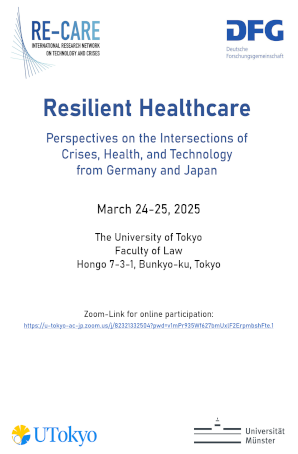
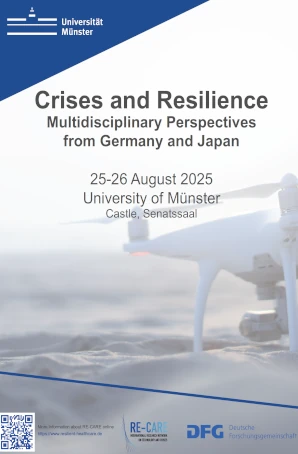
In response to escalating global crises, public and scholarly debates in Germany and Japan increasingly focus on how technologies can strengthen societal resilience. Key domains include e-health, AI, sensor-based systems, robotics, and telemedicine. Yet a significant gap remains in cross-cultural, cross-disciplinary dialogue that situates these technologies within specific crisis contexts and draws on insights from sociology, cultural and legal studies, sport science, philosophy, ethics, computer science, and medicine. RE-CARE addresses this gap by pursuing three objectives:
To examine how society and culture shape understandings of and responses to crises;
To clarify the potential of technologies in areas such as care work, sport, and public health; and
To lay the groundwork for future German-Japanese collaboration.
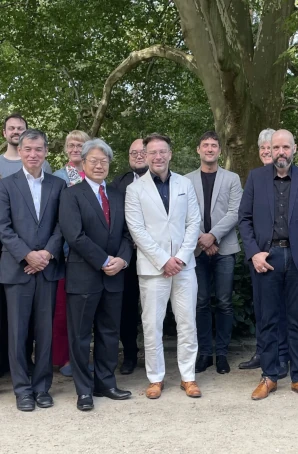
Funding: German Research Foundation (DFG) Duration: From 06/2024 PI: Dr. Dennis Krämer (Münster) Collaborators in Japan: Prof. Dr. Shigeto Yonemura (Tokyo), Prof. Dr. Susanne Brucksch (Tokyo), Prof. Dr. Satoshi Kodama (Kyoto), Prof. Dr. Kaori Sasaki (Sapporo), Prof. Dr. Yoshinori Nakata (Tokyo), Prof. Dr. Kunhao Yang (Yamaguchi) Collaborators in Germany: Prof. Dr. Gesa Lindemann (Oldenburg), Prof. Dr. Dennis Dreiskämper (Dortmund), Prof. Dr. Dr. Jochen Vollmann (Bochum), Prof. Dr. André Hajek (Hamburg), Dr. Tanja Bogusz (Hamburg), Prof. Dr. Robert Ranisch (Potsdam), Dr. Markus Bohlmann (Münster), Dr. Joschka Haltaufderheide (Potsdam), Dr. Gabriel Bartl (Berlin) Website: https://www.resilient-healthcare.de
Topic-Related Events
Artificial Intelligence in Sport [AIS]
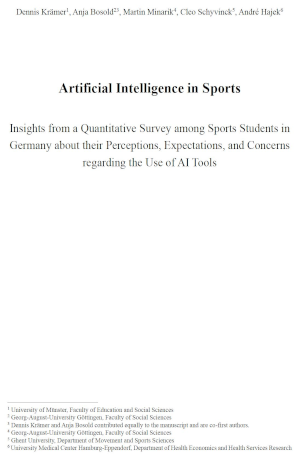
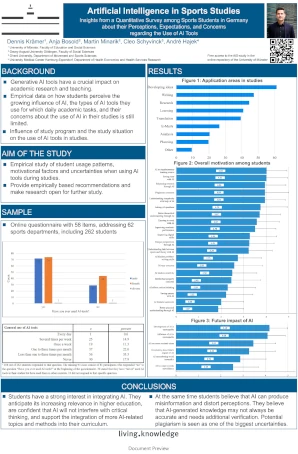
Generative AI tools (e.g. ChatGPT, Copilot, Gemini) are transforming research and teaching in higher education. However, empirical evidence on students’ perceptions of AI’s role, including tool adoption, expectations for routine study tasks, and concerns about use, remains scarce. The project “Artificial Intelligence in Sport” (AIS) addresses this gap through a quantitative study. Funding: Private funding Duration: From 06/2023 Initiator: Dr. Dennis Krämer (Münster) Collaborators: Prof. Dr. André Hajek (Hamburg), Dr. Martin Minarik (Göttingen), Anja Bosold, M.A. (Göttingen), Dr. Cleo Schyvinck (Ghent) Website / First Results: https://arxiv.org/abs/2503.05785
Topic-Related Publications
Prestudy: Artificial Intelligence in Sport
Poster Presentation: First Findings
Technologies of the Covid-19 Pandemic – A Transnational Dialogue between Germany and Japan [TECHCO]
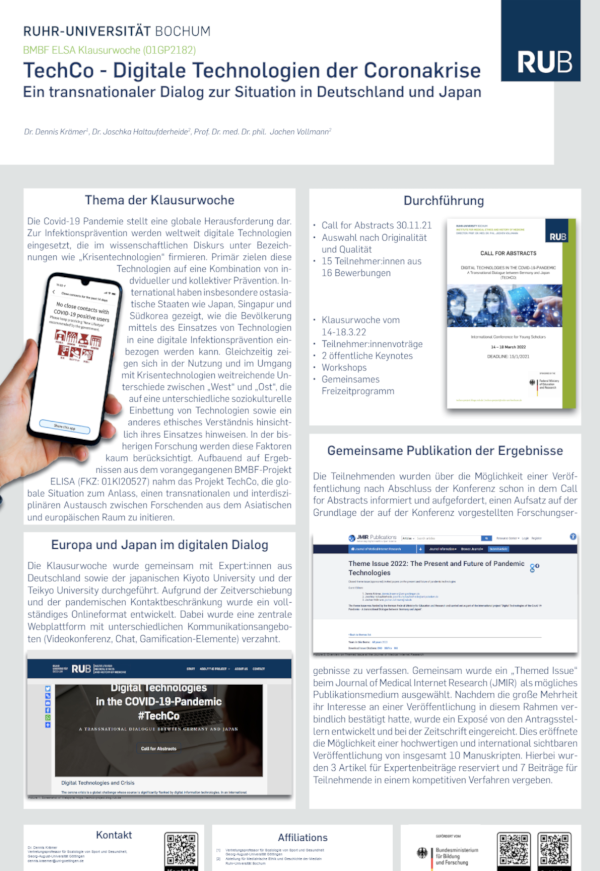
COVID-19 was—and remains—a global challenge in which digital technologies have played a key role. In interdisciplinary research, these technologies are often grouped into three functional domains: information, communication, and containment. Highly digitised East Asian countries have shown how the public can participate actively in a digital pandemic response. Yet the deployment and governance of these tools also reveal marked differences between the so-called ‘West’ and ‘East’, grounded in distinct sociocultural foundations. TECHCO aims to foster a socioculturally sensitive dialogue. By comparing Germany and Japan and analysing salient crisis-technology cases, we seek to illuminate how cultural distinctions shape societal responses to emergencies.
Funding: German Federal Ministry of Research, Technology and Space (BMFTR) Duration: 11/2021-12/2022 PI: Dr. Dennis Krämer (Münster), Dr. Joschka Haltaufderheide (Potsdam)
Topic-Related Publications
The Present and Future of Pandemic Technologies
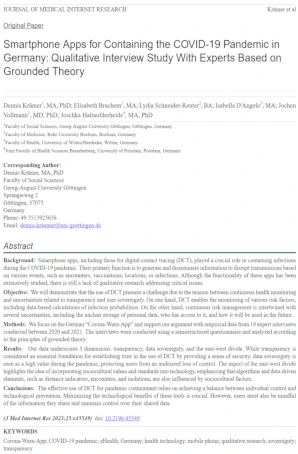
Smartphone Apps for Containing the COVID-19 Pandemic in Germany
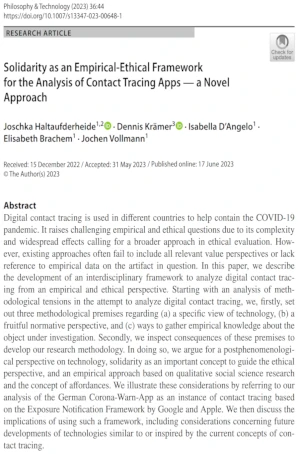
Solidarity as an Empirial-Ethical Framework
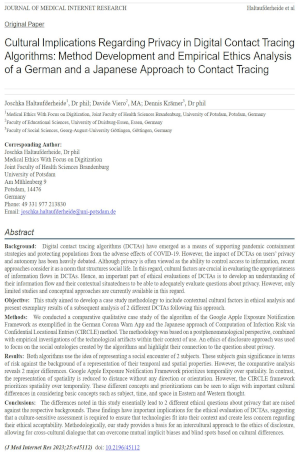
Cultural Implications Regarding Privacy in Digital Algorithms
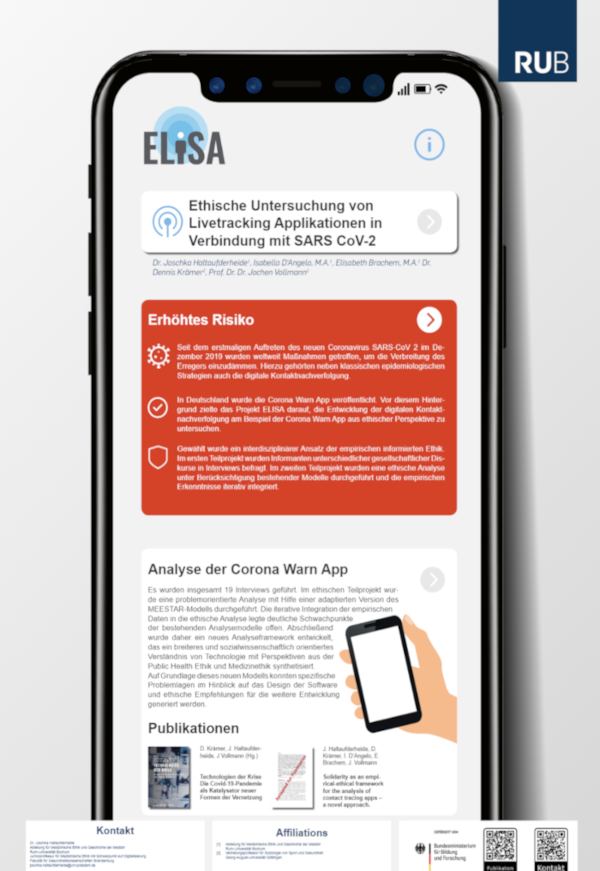
The Ethics of Livetracking-Applications in Connection with SARS-COV-2 [ELISA]
ELISA aims to examine the roles and capabilities of real-time e-health technologies during the COVID-19 pandemic. To this end, it conducts a qualitative study to explore two discursive fields: (1) biomedical and health-professional discourse (medical associations, hospital personnel, professional bodies); and (2) critical expert discourse (scientists, IT specialists, civil-society actors/activists).
Funding: German Federal Ministry of Research, Technology and Space (BMFTR) Duration: 10/2020-12/2021 PI: Dr. Dennis Krämer (Münster), Dr. Joschka Haltaufderheide (Potsdam)
Topic-Related Publications
Technologien der Krise – Die Covid-19 Pandemie als Katalysator neuer Formen der Vernetzung
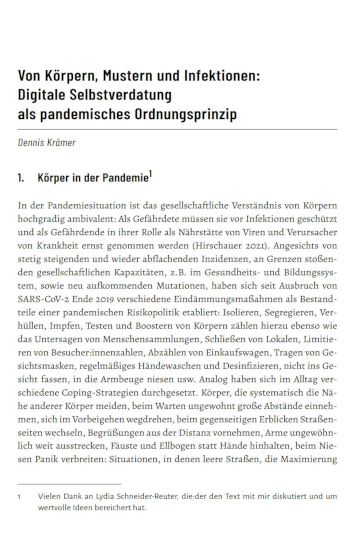
Von Körpern, Muster und Infektionen: Digitale Selbstverdatung als pandemisches Ordnungsprinzip
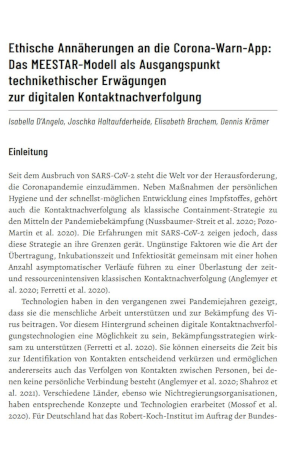
Ethische Annäherungen an die Corona-Warn-App – Das MEESTAR-Modell als Ausgangspunkt technikethischer Erwägungen
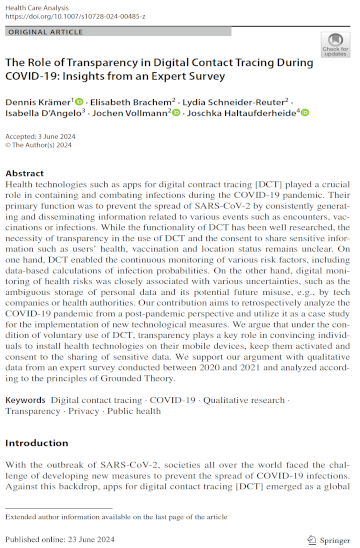
The Role of Transparency in Digital Contact Tracing During COVID‑19: Insights from an Expert Survey
Intersex in Sport
The doctoral monograph, based on a discourse analysis conducted at the University of Hamburg, examines the evolution of media and medical debates about intersex athletes in elite sport from the twentieth to the twenty-first centuries. It shows how core elements of modern sport (binary sex classification; medical intervention and the ‘normalisation’ of intersex bodies; and notions of fair play and competitive equity) are negotiated within the social context of each era. The study centres on three emblematic athletes, each representing a specific period and episteme regarding how sex, identity, and gender boundaries were understood: Dora Ratjen (1930s), Ewa Klobukowska (1960s), and Caster Semenya (early twenty-first century). The thesis received a Young Researcher Award from the German Sociological Association and a science award from the German Olympic Sports Confederation.
Duration: 2015-2020 Supervisors: Prof. Dr. Gabriele Klein (Hamburg University), Prof. Dr. Arne Dekker (University Medical Center Hamburg)
Topic-Related Publications
Intersexualität im Sport. Mediale und medizinische Körperpolitiken
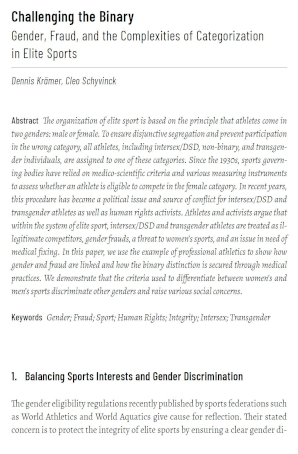
Challenging the Bainry: Gender, Fraud, and the Complexities of Categorization in Elite Sports
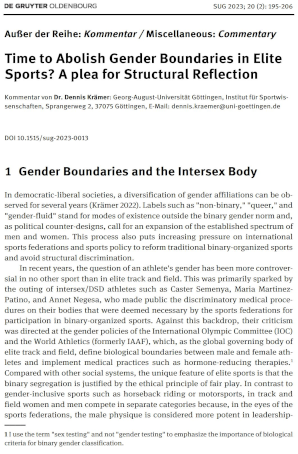
Time to Abolish Gender Boundaries in Elite Sports? A Plea for Structural Reflection
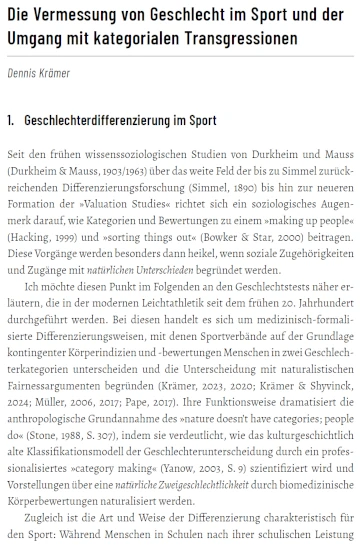
Die Vermessung von Geschlecht im Sport und der Umgang mit kategorialen Transgressionen